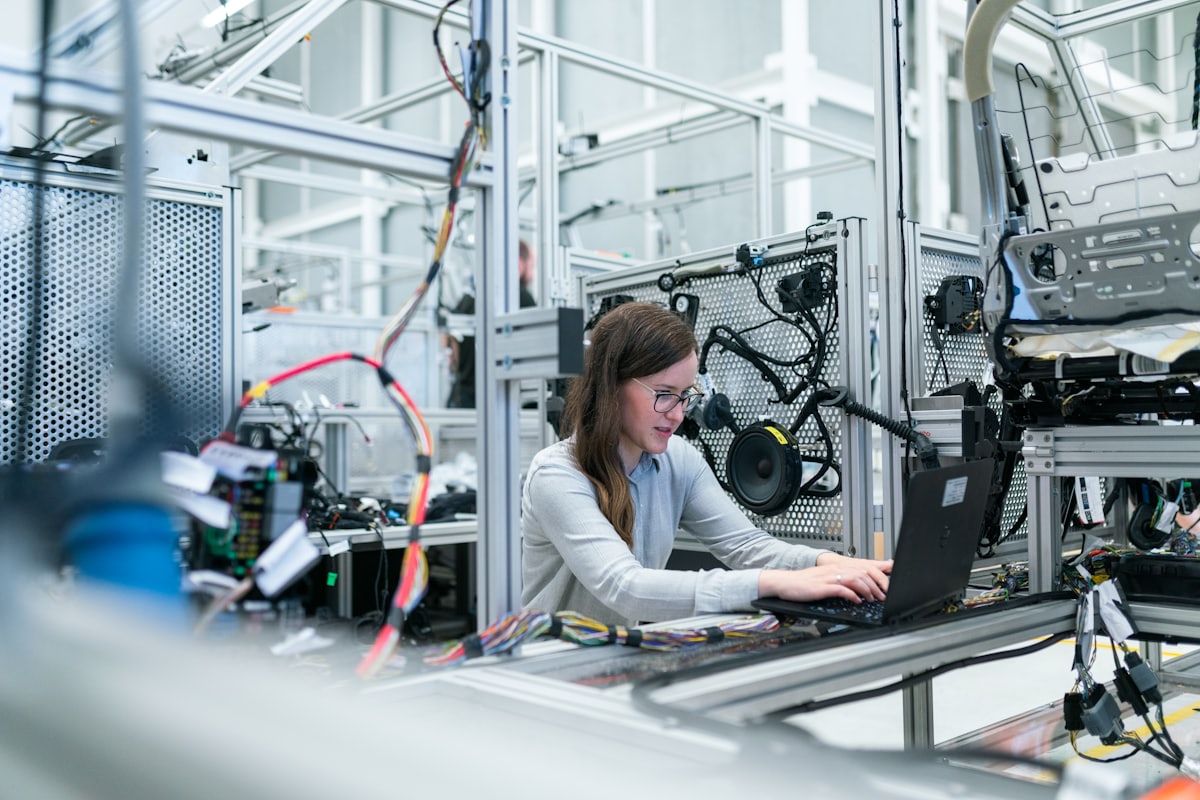
The fourth industrial revolution, or Industry 4.0, is transforming manufacturing through smart technology, and mechanical design is at the forefront of this transformation. What started as a concept in German manufacturing has evolved into a global movement that's reshaping how we design, manufacture, and maintain mechanical systems.
At Mazi Inc., we're incorporating Industry 4.0 principles into our design processes, ensuring our clients benefit from the latest advancements in smart manufacturing technology. This article explores how mechanical designers can leverage these technologies to create more intelligent, efficient, and connected products.
The Four Pillars of Industry 4.0
Industry 4.0 rests on four key technological pillars that are transforming mechanical design:
Cyber-Physical Systems
Integration of computational algorithms and physical components
Internet of Things
Networked devices collecting and sharing data in real-time
Big Data & Analytics
Data-driven insights for optimization and predictive maintenance
AI & Machine Learning
Intelligent systems that learn and adapt autonomously
Digital Twins and Virtual Commissioning
One of the most significant advancements is the creation of digital twins - virtual replicas of physical systems that can be tested and optimized before manufacturing. This approach reduces prototyping costs and accelerates time to market.
What are Digital Twins?
A digital twin is a virtual model that accurately reflects a physical object. The twin uses data from sensors on the physical object to simulate the real-world object's behavior and monitor its operations.
Benefits of Digital Twins in Mechanical Design
- Reduced Prototyping Costs: Test designs virtually before physical production
- Faster Time to Market: Identify and resolve issues early in the design process
- Predictive Maintenance: Monitor equipment health and predict failures
- Performance Optimization: Continuously improve system performance based on real data
Virtual Commissioning
Virtual commissioning takes digital twins a step further by simulating the entire manufacturing process. This allows engineers to:
- Test control logic and automation sequences
- Validate robot trajectories and collision detection
- Optimize production line layout
- Train operators in a risk-free environment
IoT-Enabled Designs
Modern mechanical designs increasingly incorporate sensors and connectivity features, allowing equipment to communicate performance data and maintenance needs. This requires designers to consider not just physical form and function, but also data collection and transmission capabilities.
Designing for Connectivity
When designing IoT-enabled equipment, mechanical engineers must consider:
Sensor Integration
- Vibration and acceleration sensors for equipment health
- Temperature and pressure sensors for process monitoring
- Proximity sensors for safety and positioning
- Strain gauges for structural integrity monitoring
Data Transmission
- Wireless communication protocols (Wi-Fi, Bluetooth, LoRaWAN)
- Power requirements for communication modules
- Antenna placement and signal strength
- Data security and encryption
Real-World Application
We recently designed an industrial processing system that incorporated IoT sensors to monitor:
- Motor temperature and vibration
- Bearing wear through acoustic monitoring
- Fluid flow rates and pressures
- Energy consumption patterns
This data is transmitted to a cloud platform where machine learning algorithms predict maintenance needs and optimize performance, reducing downtime by 35% and energy consumption by 22%.
Additive Manufacturing Considerations
Industry 4.0 has accelerated the adoption of additive manufacturing (3D printing), which requires different design thinking than traditional subtractive methods. Design for additive manufacturing (DfAM) principles are becoming essential knowledge for mechanical engineers.
DfAM Principles
- Topology Optimization: Designing parts with minimal material for maximum strength
- Lattice Structures: Using internal lattice patterns to reduce weight while maintaining strength
- Part Consolidation: Combining multiple components into single printed parts
- Support Structure Design: Minimizing support material and optimizing print orientation
Industry 4.0 Integration
Additive manufacturing becomes truly powerful when integrated with other Industry 4.0 technologies:
- Digital twins for print simulation and optimization
- IoT sensors for real-time print monitoring
- AI for automatic defect detection and correction
- Cloud-based design repositories for on-demand manufacturing
Implementing Industry 4.0 at Mazi Inc.
At Mazi Inc., we've integrated Industry 4.0 principles into our design workflow through several key initiatives:
Our Industry 4.0 Toolkit
- Digital Twin Development: Creating virtual models for all major design projects
- IoT Sensor Integration: Designing equipment with built-in monitoring capabilities
- Data Analytics Platform: Using machine learning to optimize design performance
- Additive Manufacturing: Leveraging 3D printing for prototypes and production parts
- Cloud Collaboration: Enabling real-time collaboration with clients and partners
Success Story: Smart Conveyor System
One of our recent projects involved designing a smart conveyor system for a packaging facility. The system incorporates:
- Vibration sensors for predictive maintenance
- Vision systems for package tracking
- Digital twin for performance simulation
- Cloud-based monitoring dashboard
The result was a 40% reduction in maintenance costs and a 25% increase in throughput through optimized operation.
Getting Started with Industry 4.0
For organizations looking to embrace Industry 4.0 in their mechanical design processes, we recommend:
- Start with a Pilot Project: Choose a manageable project to test Industry 4.0 concepts
- Focus on Data: Identify what data would be most valuable to collect and analyze
- Build Digital Capabilities: Develop skills in digital twin creation and data analytics
- Partner with Experts: Work with companies experienced in Industry 4.0 implementation
- Think Long-Term: Plan for scalability and future technology integration
Conclusion
Industry 4.0 represents a fundamental shift in how we approach mechanical design. By embracing digital twins, IoT connectivity, additive manufacturing, and data analytics, mechanical engineers can create smarter, more efficient, and more connected products.
The transition to Industry 4.0 isn't just about adopting new technologies—it's about transforming our design philosophy to create products that are intelligent, adaptable, and continuously improving.
At Mazi Inc., we're excited to be at the forefront of this transformation, helping our clients leverage Industry 4.0 technologies to achieve their business objectives and stay competitive in an increasingly digital world.
Related Articles
The Future of Design Automation
How automation is transforming engineering workflows
Read More →Sustainable Design Practices
Eco-friendly approaches to mechanical design
Read More →