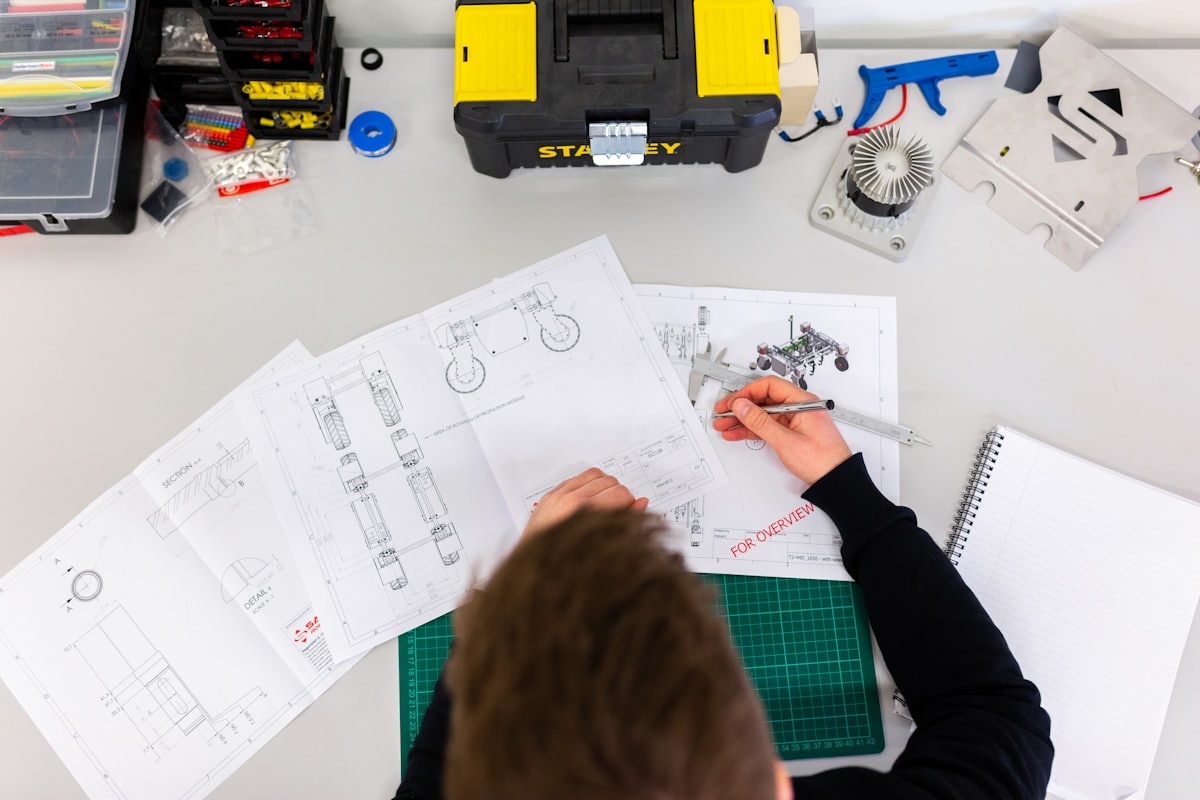
Design for Manufacturing (DFM) is the engineering practice of designing products in a way that makes them easy to manufacture. This approach fundamentally changes how we think about product development, shifting focus from just meeting functional requirements to optimizing for production efficiency, cost reduction, and quality improvement.
At Mazi Inc., we've seen DFM principles reduce manufacturing costs by 30-50% while simultaneously improving product quality and reliability. This article explores the key principles of DFM and how to apply them effectively in mechanical design projects.
The Core Principles of DFM
Successful DFM implementation rests on five fundamental principles that guide design decisions throughout the product development process.
1. Process
Design for the specific manufacturing process being used, whether it's machining, casting, injection molding, or fabrication.
2. Design
Simplify geometry, reduce part count, and design for ease of assembly and disassembly.
3. Material
Select materials that are readily available, cost-effective, and suitable for the chosen manufacturing process.
4. Tolerance
Apply appropriate tolerances - tight enough for function but loose enough for cost-effective manufacturing.
5. Testing
Design for easy inspection, testing, and quality control throughout the manufacturing process.
DFM for Different Manufacturing Processes
Each manufacturing process has unique requirements and constraints that must be considered during design.
Machining (CNC) Design Guidelines
CNC Machining Best Practices
- Internal Radii: Match tool radii to avoid special tooling
- Wall Thickness: Maintain consistent wall thickness
- Deep Pockets: Avoid depths greater than 4x tool diameter
- Undercuts: Minimize or design for standard tool access
- Setups: Design for minimal machine setups
Injection Molding Design Guidelines
Plastic Part Design Principles
- Draft Angles: 1-2° minimum for easy part ejection
- Uniform Wall Thickness: Prevent sink marks and warpage
- Rib Design: 40-60% of nominal wall thickness
- Gate Locations: Consider flow lines and weld lines
- Boss Design: Proper reinforcement and hole alignment
Sheet Metal Design Guidelines
Sheet Metal Fabrication Rules
- Bend Relief: Proper notches for adjacent bends
- Hole Placement: Keep holes away from bend lines
- Minimum Flange: 4x material thickness minimum
- Hem Types: Choose appropriate hem styles
- Tooling Clearance: Account for press brake tooling
Design for Assembly (DFA) Principles
DFA focuses on simplifying the assembly process, reducing part count, and making assembly intuitive and error-proof.
Key DFA Strategies
Minimize Part Count
Ask these questions for every part:
- Does the part move relative to all other parts?
- Must the part be made of different material?
- Must the part be separate for assembly access?
- Does separating the part simplify manufacturing?
Error-Proofing (Poka-Yoke)
- Asymmetric Features: Make incorrect assembly impossible
- Keyed Connectors: Prevent wrong orientation
- Color Coding: Visual indicators for correct assembly
- Unique Fasteners: Different screw types for different locations
Assembly Sequence Optimization
- Design for top-down assembly
- Minimize reorientation during assembly
- Provide adequate access for tools
- Design for easy alignment and positioning
- Consider service and maintenance access
Tolerance Analysis and Stack-ups
Proper tolerance application is crucial for function, cost, and manufacturability.
Tolerance Strategy
Tolerance Best Practices
- Use standard tolerances unless function requires otherwise
- Apply geometric tolerancing for complex relationships
- Consider process capabilities when setting tolerances
- Use datum structures that match manufacturing setup
- Perform tolerance stack-up analysis for critical features
Cost vs. Tolerance Relationship
Understanding the exponential cost increase with tighter tolerances:
- ±0.5mm: Standard machining - low cost
- ±0.1mm: Precision machining - moderate cost
- ±0.025mm: High-precision machining - high cost
- ±0.005mm: Very high precision - very high cost
Material Selection for Manufacturing
Material choices significantly impact manufacturing cost, process selection, and lead times.
Material Selection Factors
Key Considerations
- Availability: Standard sizes and grades reduce cost
- Machinability: Materials with good machinability ratings
- Formability: For sheet metal and forming operations
- Weldability: For fabrication and assembly
- Thermal Properties: For casting and molding processes
Common Material Trade-offs
- Aluminum vs. Steel: Weight vs. strength and cost
- Plastics vs. Metals: Corrosion resistance vs. strength
- Stainless vs. Carbon Steel: Corrosion resistance vs. cost
- Composites vs. Metals: Weight savings vs. manufacturing complexity
Design for Cost Reduction
Systematic approaches to identifying and eliminating unnecessary costs in product design.
Cost Drivers in Manufacturing
Major Cost Factors
- Material Cost: 40-60% of part cost typically
- Machine Time: Setup time + cycle time
- Labor: Direct and indirect labor costs
- Tooling: Custom fixtures, molds, and tooling
- Quality Control: Inspection and testing requirements
Cost Reduction Strategies
- Design for standard stock sizes
- Minimize secondary operations
- Use standard components and fasteners
- Design for multi-cavity molding or multiple parts per blank
- Optimize material utilization and nesting
Case Study: Industrial Equipment Redesign
We recently applied DFM principles to redesign an industrial equipment enclosure, achieving significant improvements.
Original Design Challenges
- 45 individual parts
- Complex assembly requiring special tools
- High scrap rate due to tight tolerances
- Long lead time for custom components
- Difficult service access
DFM Redesign Solutions
- Reduced to 22 parts through part consolidation
- Standardized all fasteners to two types
- Relaxed non-critical tolerances
- Designed for tool-less assembly where possible
- Added service access panels
Results Achieved
- 38% reduction in manufacturing cost
- 65% reduction in assembly time
- 90% reduction in assembly errors
- 50% reduction in service time
- Improved product reliability
DFM Checklist for Mechanical Designers
Use this comprehensive checklist to evaluate your designs for manufacturability:
- Part Count Minimization: Have you eliminated unnecessary parts through consolidation?
- Standard Components: Are you using standard fasteners, bearings, and components?
- Tolerance Optimization: Are tolerances as loose as function allows?
- Process Compatibility: Is the design optimized for the chosen manufacturing process?
- Assembly Access: Can all parts be easily assembled and serviced?
- Material Selection: Are materials readily available and cost-effective?
- Error-Proofing: Is the design mistake-proof for assembly?
- Testing Access: Can the product be easily tested and inspected?
Implementing DFM in Your Organization
Successfully integrating DFM requires cultural and process changes across the organization.
Implementation Strategy
Key Success Factors
- Early Involvement: Include manufacturing engineers in design reviews
- Cross-Functional Teams: Collaboration between design and manufacturing
- DFM Training: Educate designers on manufacturing processes
- Standardization: Develop company-specific DFM guidelines
- Continuous Improvement: Learn from manufacturing feedback
Measuring DFM Success
- First-pass yield rates
- Manufacturing cost reductions
- Assembly time improvements
- Quality metric improvements
- Time-to-market reductions
Conclusion
Design for Manufacturing is not just a set of rules—it's a mindset that prioritizes production efficiency, cost-effectiveness, and quality throughout the design process. By applying DFM principles systematically, companies can achieve significant competitive advantages through reduced costs, improved quality, and faster time-to-market.
The most successful DFM implementations involve close collaboration between design and manufacturing teams, early consideration of production constraints, and continuous improvement based on real-world manufacturing experience.
At Mazi Inc., we've seen that investing in DFM upfront pays substantial dividends throughout the product lifecycle. Whether you're designing simple components or complex assemblies, applying these principles will lead to better, more manufacturable designs.
Related Articles
Advanced Pressure Vessel Design
Complex vessel design considerations
Read More →The Future of Design Automation
Efficiency through automation
Read More →